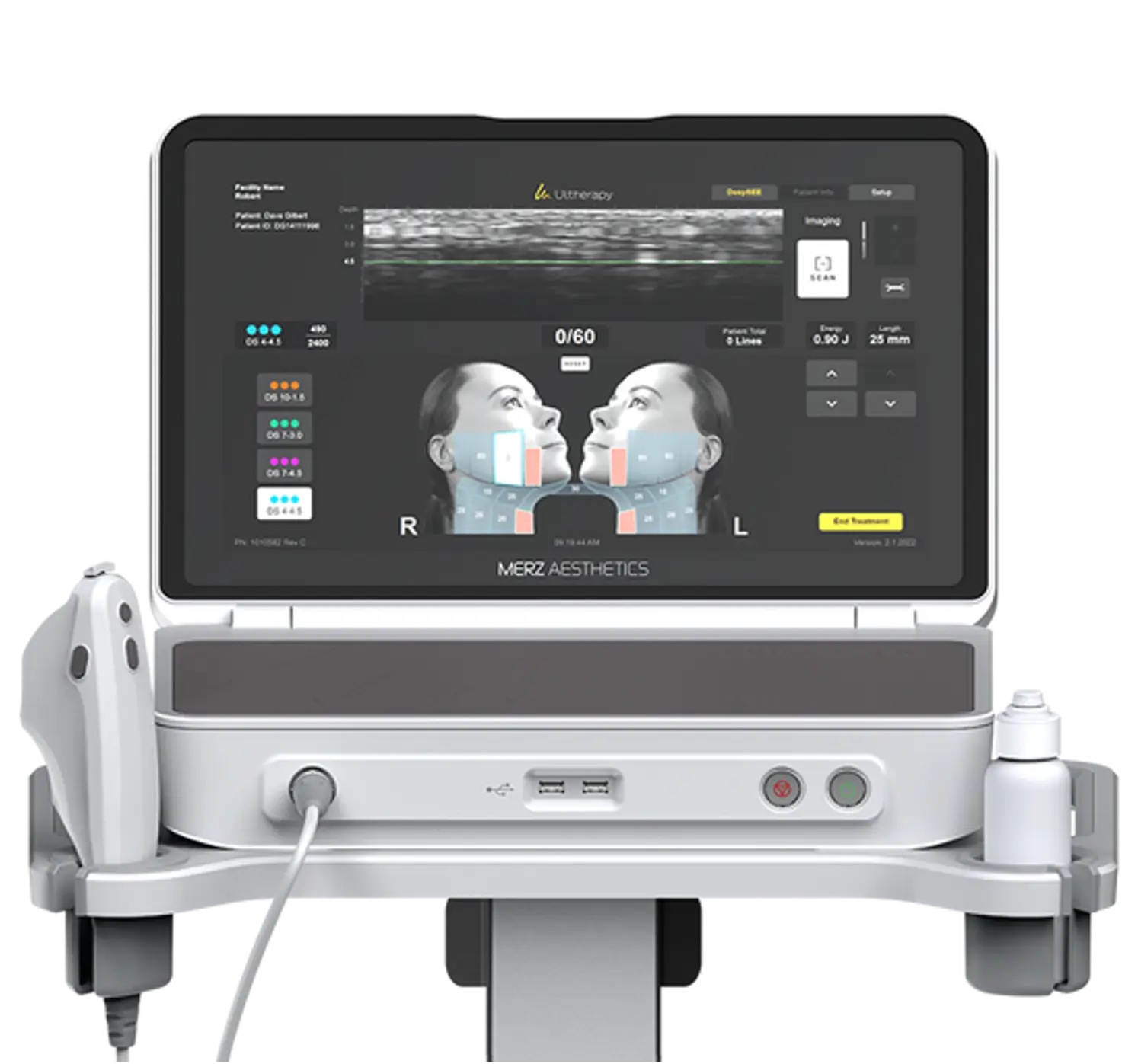

Among energy-based treatments aimed at skin tightening and reshaping the facial oval, Ultherapy® has become one of the most talked-about non-surgical facelift options.
But does it really give the same results for everyone?
The short answer is: no.
One of the most important factors determining the success of Ultherapy is the person’s face type, skin quality, and level of sagging. Because this treatment is not a “volume-adding” procedure; it is a procedure to tighten existing tissue and support collagen production.
How Does Ultherapy Work?
Ultherapy creates controlled heat points by delivering focused ultrasound energy to the lower layers of the skin. The aim is to trigger collagen production, which decreases over time, and to provide tightening in the tissue.
It can be particularly effective in individuals who need:
– reduced definition in the jawline,
– mild to moderate sagging,
– downward sagging in the cheek tissue,
– tightening under the neck.
However, the important point here is:
Ultherapy is not a “removal of excess skin” procedure. Therefore, while some facial types benefit much more from treatment, there may be a difference between expectations and results in some individuals.
Facial Types in Which Ultherapy is More Successful
1. Thin or Medium Thick Skin Structure
Generally, thin to medium-thick skin that has begun to lose elasticity but has not yet sagged to an advanced level is the group that responds best.
In these individuals:
– collagen stimulation becomes more visible,
– the facial contour is more clearly tightened,
– the softening of the jawline responds better.
In particular, patients who say:
– “I’m starting to look tired”
– “my face seems to be drooping”
– “I used to have a more defined jawline” are generally good candidates.
2. Faces with Mild to Moderate Sagging
This is one of the areas where Ultherapy is strongest.
It can provide a natural and controlled tightening in individuals with:
– prejowl area irregularities,
– mild double chin,
– downward sagging in the cheek,
– loss of elasticity in the neck, which are not yet advanced enough to require surgery.
The goal here is not to “change” the face, but to create a more rested and firm appearance.
3. Those with Tissue Sagging Rather Than Excess Volume in Their Face
In some people, the problem is not a lack of volume, but a downward displacement of tissue.
For example:
– the face looks heavy,
– the nasolabial area becomes more prominent,
– the jawline becomes blurred,
– the lower face begins to look wider.
Better results can be obtained in these individuals with the right energy planning.
The tightening effect is more noticeable, especially in people whose faces are not very full.
Which Face Types May Have More Limited Results?
1. Faces with Advanced Sagging
In cases where excess skin is significant and tissue has shifted significantly downwards, Ultherapy alone may not be sufficient.
In these individuals:
– if expectations are very high,
– if there is an expectation of a “non-surgical facelift”,
– if excess skin is prominent, the result may be perceived as insufficient.
In some patients, combined treatments or surgical options may be more appropriate.
2. Very Heavy and Thick Facial Structure
In individuals with a heavy lower facial structure and dense fat tissue, the tightening effect may be felt more limitedly.
This is because the problem is not only collagen loss, but also:
– tissue weight,
– excess volume,
– downward mechanical load
In this group, sometimes:
– weight control,
– combination with different energy-based systems (such as RF microneedling),
– Ultherpy sessions repeated at more frequent intervals,
– combination with supportive injections are considered.
3. Very Thin and Volume-Losing Faces
This group requires a little more attention.
In very thin faces where volume loss is already significant, aggressive tightening can sometimes make the person look even more “sagged”.
Therefore, in this type of patient:
– energy density,
– application area,
– combined biostimulant approaches become important.
Sometimes it is more correct to support the quality first, then perform tightening.
Is Age More Important, or Face Type?
Actually, biological age is often more important than chronological age.
A 35-year-old individual with:
– severe sun damage,
– reduced elasticity,
– rapid volume loss may show more sagging than a 45-year-old individual.
Therefore, when making a decision, not only age but also:
– skin quality,
– fat distribution,
– bone support,
– facial weight,
– elasticity level should be evaluated together.
When Will Results Be Seen After Ultherapy?
A slight tightening may be felt in the first few weeks, but the main effect usually becomes noticeable within 3-4 months. Since collagen remodeling continues, the results settle over time.
Therefore, Ultherapy is better understood when evaluated with the expectation of:
– “natural tightening over time” rather than:
– “immediate dramatic change”.
In conclusion,
Ultherapy is a method that can be quite successful in the right patient.
However, not every face type responds in the same way.
Generally, the best candidates are:
– those with mild to moderate sagging,
– those whose skin elasticity has not been completely lost,
– those whose face is not too heavy,
– those who want natural tightening.
The most important aspect of treatment planning is accurately analyzing the individual’s facial anatomy and aging process. Sometimes, the need may not be for tightening, but rather volume support, quality enhancement, or a combined approach.


