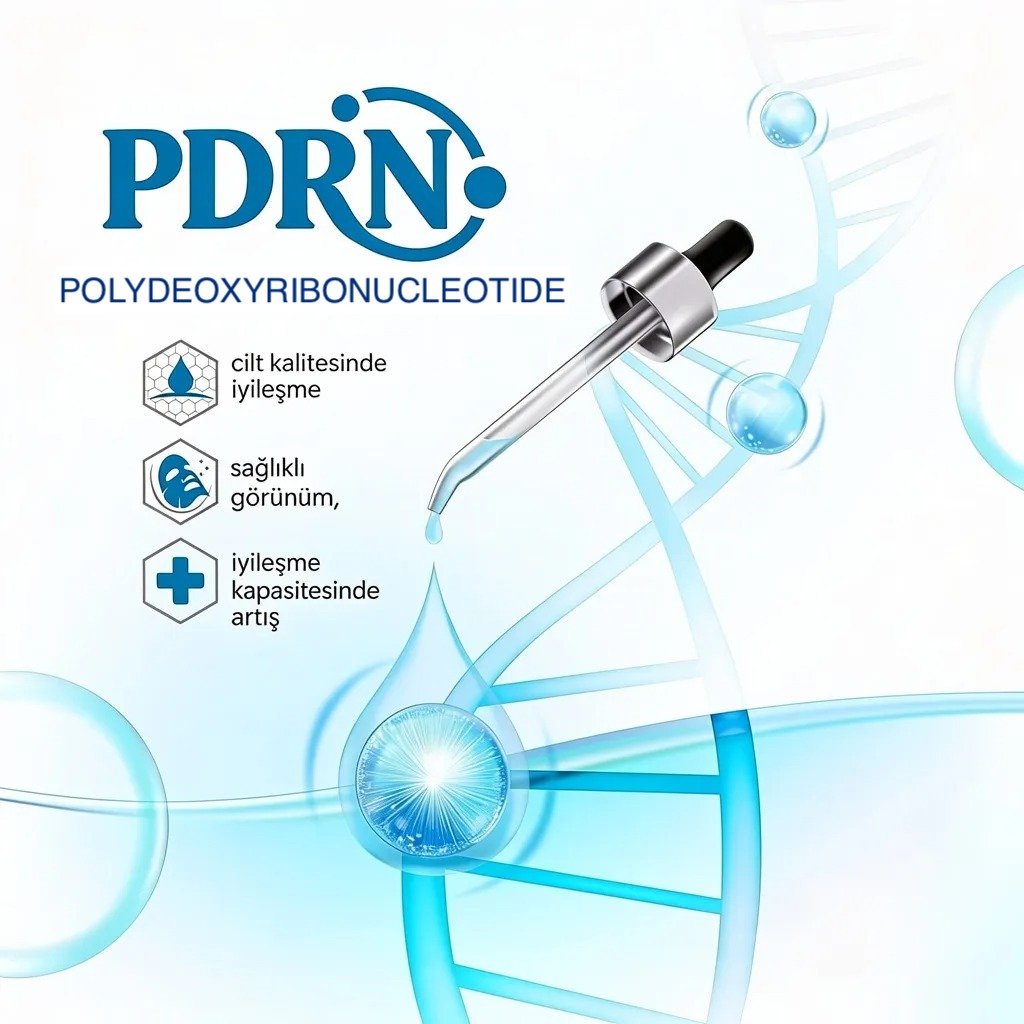

What is Salmon DNA / PDRN? Does it Really Rejuvenate the Skin?
In recent years, one of the most frequently heard terms in the world of medical aesthetics is “salmon DNA.” It has become a popular application, particularly for improving skin quality, achieving a more vibrant and healthy appearance, reducing fine wrinkles, and supporting the skin barrier.
So what exactly is “salmon DNA”? Is DNA really being injected? Is it the same as PDRN? What do scientific data tell us?
In this article, we will discuss what PDRN (Polydeoxyribonucleotide) is, how it works, and its potential effects on the skin, in light of current scientific publications.
What is PDRN?
PDRN (Polydeoxyribonucleotide) is a biological molecule composed of DNA fragments of specific lengths. It is most often obtained from salmon sperm and is prepared with high purity.
In fact, most of the applications known as “salmon DNA” among the public are technically PDRN or polynucleotide-based products.
Scientific publications have shown that PDRN:
– supports tissue repair,
– can accelerate wound healing,
– can reduce inflammation,
– supports fibroblast activity,
– can increase collagen production.
Why is PDRN obtained specifically from salmon?
It is stated that the base structure of salmon-derived DNA is highly similar to human DNA.
In addition, salmon sperm has been the most common source of PDRN for many years due to:
– its high amount of DNA content,
– its suitability for purification,
– its biocompatibility.
However, in recent years, studies are increasing on obtaining PDRN not only from salmon but also from plant sources such as:
– sea cucumber,
– starfish,
– red algae,
– and even ginseng.
This suggests that we may be talking more about new generation products such as “vegan PDRN” in the future.
How does PDRN affect the skin?
One of the most important effects of PDRN is that it supports fibroblast activity.
Fibroblasts:
– are key cells in collagen production,
– maintaining elasticity,
– wound healing,
– skin quality.
Studies show that PDRN can support the vitality and growth of fibroblasts.
In addition, it has been reported that:
– it can reduce the activity of collagen-degrading enzymes such as MMP-1,
– it can support mitochondrial activity,
– it can increase DNA repair after UV damage.
In short, the aim is not just to “provide moisture”; it is to support the skin’s biological repair capacity.
In Which Cases is Salmon DNA Preferred?
PDRN-containing applications are most frequently preferred in the following cases:
• Decreased skin quality
• Dull appearance
• Loss of elasticity
• Fine wrinkles
• Sensitive and weakened barrier skin
• Support after laser and energy-based treatments
• Acne scar and blemish support
• Eye area and thin skin areas
Does PDRN/Salmon DNA Have an Effect on Pigmentation?
Some studies show that PDRN can reduce melanin production and suppress tyrosinase activity.
Therefore, its supportive effects on:
– post-inflammatory hyperpigmentation,
– sun damage,
– uneven skin tone are being investigated.
However, the important point here is:
PDRN is not a “main spot treatment”; it should be considered more as an auxiliary approach that supports skin quality and the healing process.
What Should Be Realistic Expectations in Salmon DNA Treatment?
Salmon DNA applications are not:
– applications that dramatically lift the face,
– applications that add volume,
– applications that replace fillers.
They are more:
– biostimulant treatments aimed at improving skin quality,
– providing a more vibrant and healthy appearance,
– supporting healing capacity.
Are Salmon DNA Applications Safe?
The literature reports that PDRN is generally well tolerated and does not show serious toxicity. Of course, as with any injection procedure:
– product quality,
– application technique,
– correct patient selection,
are very important.
In conclusion,
PDRN, or “salmon DNA” as it is commonly known, is not just a trendy application; it is a biological ingredient with a growing scientific literature behind it.
In particular, there is promising data on:
– supporting the skin barrier,
– increasing fibroblast activity,
– supporting wound healing,
– improving skin quality.


